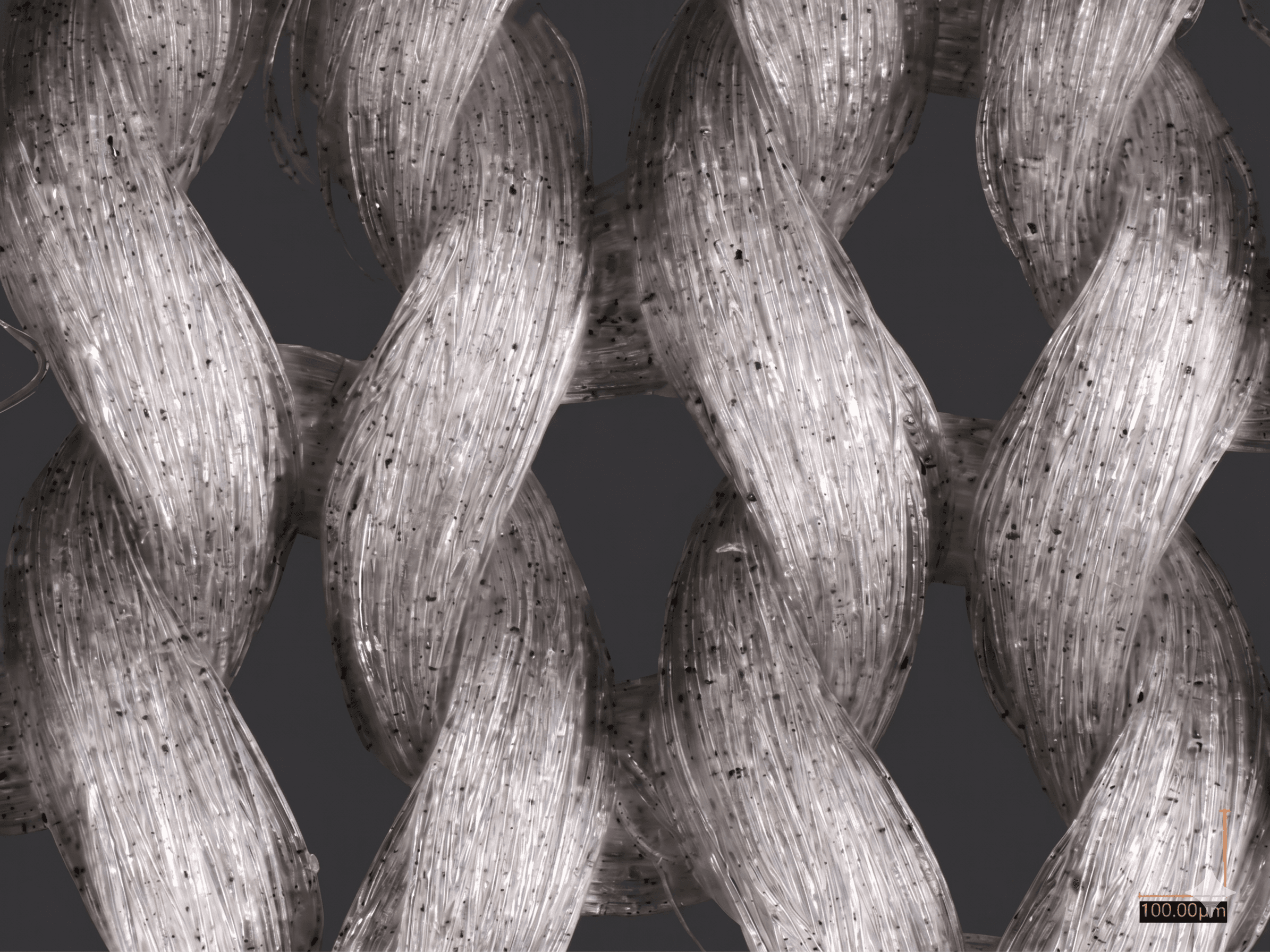
Where Additives Become the System
From simple reinforcement fillers to architected functional domains.
For decades, functional additives in polymers and fibers were treated as performance enhancers; small components dispersed within a passive matrix to improve strength, conductivity, or stability. However, this perspective is no longer sufficient.
Today, functional additives are not just “added” to polymers. They are structural agents that define the internal architecture of the material itself. We are entering an era where the fiber is not a homogeneous entity with embedded particles, but a hierarchically organized system in which additives construct pathways, networks, and interfacial domains that govern functionality at every scale.
1. The Paradigm Shift: From Addition to Architecture
Traditional composite thinking assumes that nanofillers or additives enhance properties through simple dispersion. However, recent research shows that performance is governed less by “what is added” and more by how internal structures self-organize through additive interactions [10].
Modern polymer nanocomposites demonstrate that mechanical, electrical, and thermal properties emerge from:
• interphase formation
• nanoscale connectivity
• percolated networks
• morphological confinement effects
Rather than acting as passive inclusions, additives actively reorganize polymer chain dynamics and internal geometry [2], [10]. This marks a fundamental shift:
Function is no longer introduced. It is constructed through internal architecture.
2. Molecular-Level Functional Design: Chemistry as Structure
At the smallest scale, functional additives interact directly with polymer chains through:
• hydrogen bonding
• covalent grafting
• π–π interactions
• ionic coordination
These interactions modify chain mobility, crystallinity, and local energy landscapes, effectively redefining the polymer itself as a chemically programmed structure. Recent studies show that molecular design strategies such as copolymerization and functional group incorporation allow direct tuning of physical behavior at the chain level [5].
At this scale, additives are no longer additives, they become integrated chemical features of the backbone system.
3. Nanoscale Additive Networks: The Rise of Percolation Architectures
When nanofillers such as carbon nanotubes, graphene derivatives, or metal oxides are introduced, they do not behave as isolated particles. Instead, they form connected statistical networks governed by percolation physics.
These networks define:
• electrical conduction pathways
• thermal transport channels
• mechanical load redistribution routes
The formation of such networks is highly sensitive to dispersion, aspect ratio, and interparticle interaction [7], [11]. Importantly, recent studies show that the most effective functional behavior emerges near the percolation threshold, where connectivity is maximized while mobility of the polymer matrix is still preserved [9]. Thus, functionality is not a linear function of filler content, it is a topological state of matter inside the fiber.
4. Interphase Engineering: Where Function Actually Lives
One of the most critical but often overlooked aspects of functional fibers is the interphase region between polymer and additive.
Recent work highlights that the interphase, not the filler itself, governs:
• stress transfer efficiency
• thermal resistance
• electrical tunneling behavior
• structural durability under deformation [10]
This interphase is not a boundary. It is a third phase of material, formed through molecular rearrangement and localized polymer confinement. In modern nanocomposites, performance is dictated by: interphase thickness, interphase mobility, and interphase continuity
rather than additive identity alone.
5. Microstructural Organization: Geometry as a Functional Tool
At the microscale, fiber spinning and processing methods determine how additives are spatially organized:
• aligned vs random dispersion
• core–shell structures
• layered architectures
• phase-separated domains
These structural motifs directly control anisotropy and transport behavior. Research has shown that ordered filler distribution dramatically enhances functional performance compared to random dispersion, even at identical loading levels [8]. This confirms a key principle:
In functional fibers, geometry is not a consequence of processing, it is the mechanism of function itself.
6. The Core Scientific Challenge: Controlling Multi-Scale Coupling
Despite rapid progress, a central challenge remains unresolved:
How do we maintain mechanical integrity while precisely controlling additive networks, interphase dynamics, and molecular mobility simultaneously?
This challenge arises from competing effects:
• stronger percolation improves conductivity but reduces chain mobility
• increased interphase interaction improves strength but limits relaxation
• higher filler content enhances functionality but destabilizes processability
This creates a fundamental design tension between performance, stability, and manufacturability [9], [10].
Conclusion
Functional fibers are no longer defined by what is added to them. They are defined by how additives reorganize the internal architecture of the polymer system across molecular, nanoscale, and microscale domains.
In this framework:
• molecules define local behavior
• nanofillers define connectivity
• interphases define transfer mechanisms
• microstructures define macroscopic performance
The fiber is no longer a material system with additives, It is an additive-constructed architecture of function.
References
[1] Liu et al., A Review of Multifunctional Nanocomposite Fibers: Design, Preparation and Applications, Advanced Fiber Materials, 2023.
[2] Cao et al., Modulating the percolation network of polymer nanocomposites, Journal of Applied Physics, 2020.
[3] Wang et al., Ordered polymer composite materials: challenges and opportunities, Nanoscale, 2021.
[4] Wei et al., Toolbox for processing functional polymer composites, Nano-Micro Letters, 2021.
[5] Kausar, Polyacrylonitrile-based nanocomposite fibers, 2019.
[6] Bhadra et al., Polyaniline-based polymer composites, Journal of Polymer Research, 2020.
[7] Xu et al., Thermal conductivity of polymers and nanocomposites, 2018 review framework extended in later works.
[8] Tsioptsias et al., Polypropylene nanocomposite fibers review, 2021.
[9] Jamirad et al., Interfacial thermal conductance in functional nanocomposites, 2023.
[10] Interphase-Centric Polymer Composites Review, PMC, 2025.
[11] Polymeric nanocomposites dynamics review, Progress in Polymer Science, 2020.