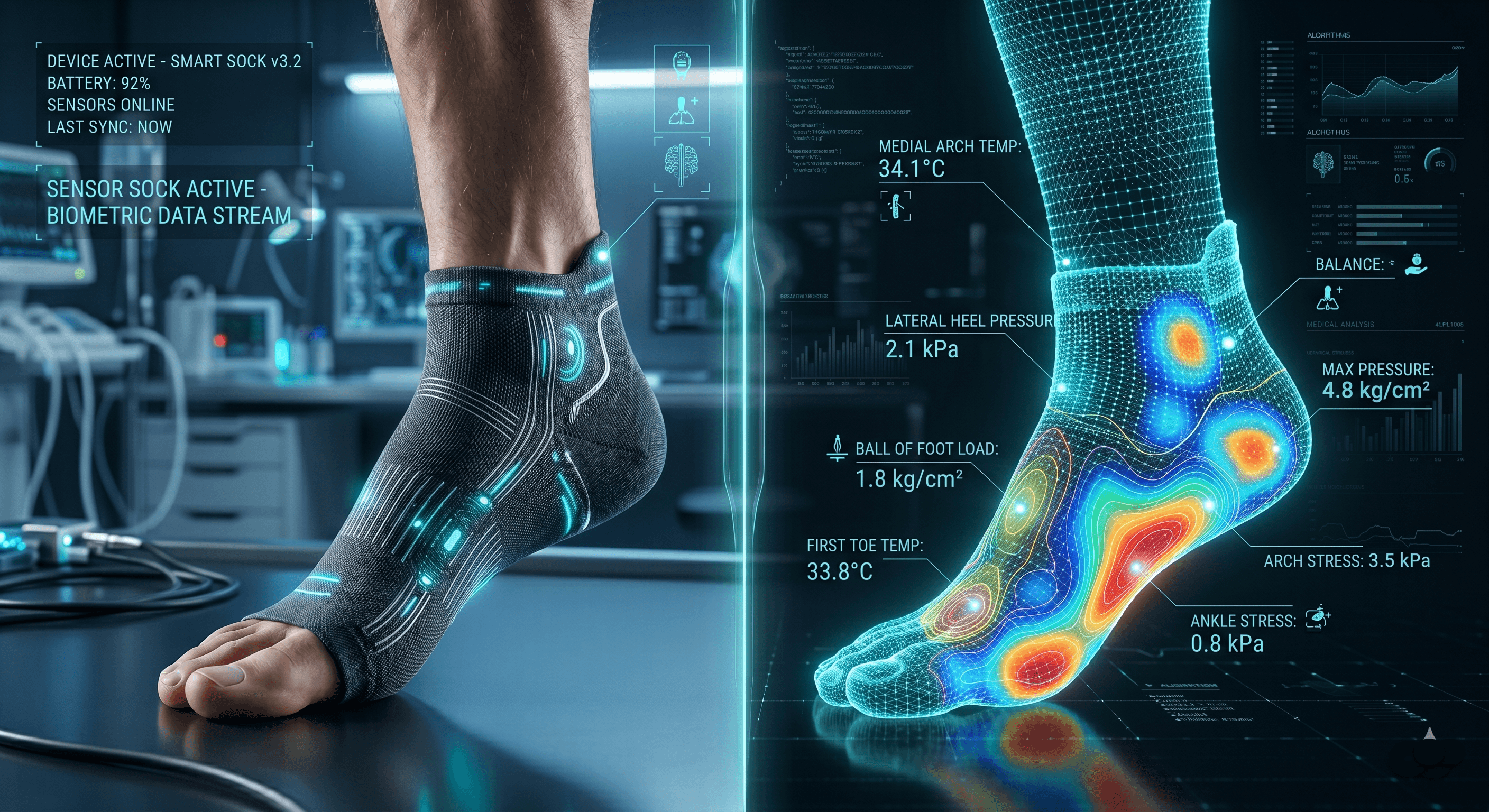
Smart textiles are often defined by their ability to sense. They capture physiological signals, motion, environmental conditions, and more continuously and in real time. As sensing technologies improve, the volume of data generated by wearable systems is increasing exponentially. But there is a critical issue that is frequently overlooked: Data alone does not create value.
In reality, the next major bottleneck in smart wearables is not sensing or even power, it is data processing and analysis.
The Data Explosion Problem
Modern smart textiles integrate multiple sensing modalities, including: Temperature, Strain and motion, Pressure & Bio-signals (e.g., heart rate, respiration).
These systems produce continuous, high-frequency, multi-dimensional data streams. While this creates opportunities for deeper insight, it also introduces significant challenges:
• Redundant & noisy signals
• Context ambiguity
• High data volume with limited relevance
Recent studies highlight that wearable systems often generate far more data than can be effectively processed or utilized, leading to inefficiencies in both performance and system design [1].
Raw Data vs. Meaningful Insight
A fundamental misconception in wearable technology is that more data leads to better outcomes. However:
• A temperature reading does not indicate health status without context
• Motion data does not directly translate to behavior or intent
• Physiological signals require interpretation, filtering, and correlation
Transforming raw signals into actionable insights requires advanced data processing pipelines, including:
• Signal conditioning
• Feature extraction
• Pattern recognition
• Context-aware interpretation
Without these layers, smart textiles remain data generators, not intelligent systems [2].
The Energy–Data Trade Off
Data processing is not free. It comes with a direct energy cost.
As discussed in previous work, smart textiles already face severe energy constraints. The challenge becomes more complex when data is considered:
• Higher sampling rates → increased power consumption
• Continuous data transmission → significant energy drain
• Cloud-based processing → latency and dependency issues
This creates a critical trade-off: More data vs. sustainable operation
Efficient systems must balance data resolution, processing location, and energy availability a problem that is now central to wearable system design [3].
Edge Processing in Smart Textiles
To address these challenges, research is shifting toward edge computing, where data is processed locally within the wearable system rather than transmitted externally. In smart textiles, this concept is even more demanding:
• Electronics must be flexible and low-power
• Processing units must tolerate deformation
• Integration must not compromise comfort or durability
Edge processing enables:
• Reduced data transmission
• Lower energy consumption
• Real-time decision making
Recent advances show that on-device intelligence can significantly improve efficiency by filtering and compressing data before transmission [4].
AI and Machine Learning: Opportunities and Limitations
Artificial intelligence is often presented as the solution to wearable data challenges. While AI enables:
• Pattern recognition
• Predictive analytics
• Personalized insights
Its integration into smart textiles is not straightforward. Key limitations include:
• Requirement for large, high-quality labeled datasets
• Variability in textile-based signals due to motion and deformation
• Computational cost and power consumption
As a result, implementing AI in wearable systems requires ultra-efficient models and robust data preprocessing strategies [5].
From Continuous Monitoring to Event-Driven Intelligence
One of the most promising approaches is shifting from continuous data collection to event-driven sensing. Instead of recording everything, systems detect meaningful changes, data is captured only when needed & processing is triggered selectively
This approach reduces energy consumption, minimizes unnecessary data & also Improves system scalability. Event-driven architectures are increasingly seen as essential for next-generation smart textiles [6].
The Real Bottleneck: Intelligence at Low Power
Smart textiles are evolving from sensing platforms to intelligent systems embedded in materials.
The key challenge is no longer just capturing data, It’s extracting meaningful insight in real time, under strict energy and mechanical constraints.
This requires:
• Co-design of materials, sensors, and algorithms
• Ultra-low-power electronics
• Integrated data processing architectures
The Future: From Data to Decision
The next generation of smart wearables will not be defined by how much data they collect, but by how effectively they use it.
Future systems will move toward:
• Embedded intelligence within fibers and yarns
• Distributed processing across textile structures
• Minimal-data, high-value sensing strategies
• Autonomous decision-making at the material level
Conclusion
Smart textiles are not limited by their ability to sense the world, they are limited by their ability to understand it.
In the future of wearable technology, the most valuable component will not be the sensor or even the power source, it will be the intelligence that transforms data into action.
References
[1] Stoppa, M., & Chiolerio, A. (2020). Wearable electronics and smart textiles: A critical review. Sensors
[2] Heikenfeld, J. et al. (2021). Wearable sensors: Modalities, challenges, and prospects. Lab on a Chip
[3] Khan, Y. et al. (2020). Monitoring of vital signs with flexible and wearable medical devices. Advanced Materials
[4] Shi, W. et al. (2021). Edge computing: Vision and challenges for wearable systems. IEEE Internet of Things Journal
[5] Wang, J. et al. (2022). Machine learning for wearable devices: Challenges and opportunities. Nature Electronics
[6] Niu, S. et al. (2023). Event-driven sensing and self-powered systems in wearable electronics. ACS Nano