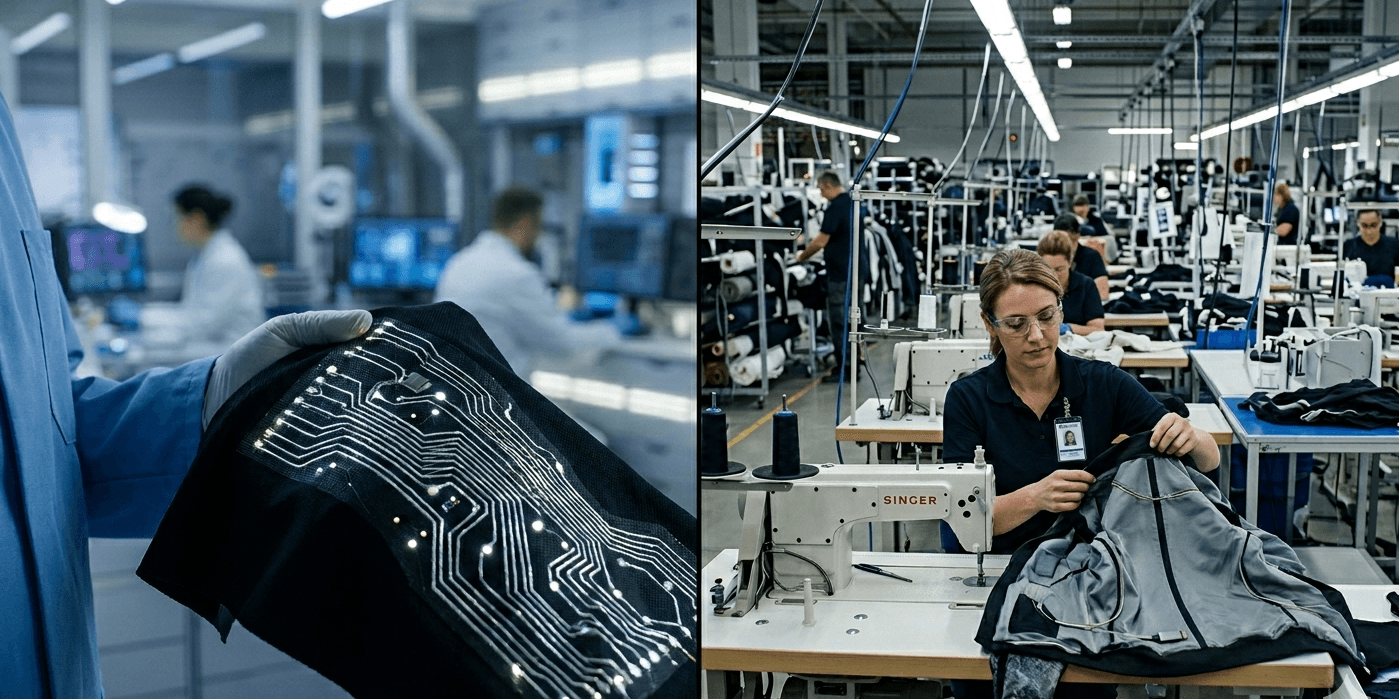
Smart textiles, fabrics embedded with sensing, responsive, or interactive capabilities are widely seen as the future of apparel and wearable technology. Yet despite strong prototypes and compelling demos, very few reach large-scale commercial success.
The core issue is not innovation, it is economics that only becomes visible at scale.
1. The Prototype Illusion: Early Success Masks True Cost
In early development, smart textiles often appear commercially viable. Small batches are manually assembled, engineering teams prioritize functionality over cost, and lab environments absorb inefficiencies.
However, these conditions hide the true production reality. When scaled, the system shifts from a controlled prototype to a fully industrialized product, and cost structures change dramatically.
2. The Hidden Cost Stack in Smart Textiles
A. High Production Cost Barrier
Smart textiles consistently show significantly higher production costs compared to conventional apparel due to integration of electronics, specialized materials, and low-volume manufacturing constraints [1]. These costs are not incremental, they compound across every layer of the product architecture.
B. Multi-Industry Supply Chain Complexity
Unlike traditional textiles, smart textiles require coordination between textile manufacturing, electronics integration, encapsulation, and sometimes software systems.
This fragmented supply chain introduces inefficiencies, longer lead times, and non-aligned cost structures across industries [2].
C. Yield Loss and Defect Sensitivity
Smart textile production is highly sensitive to defects in conductive pathways, bonding integrity, and material compatibility. Even small increases in defect rates can significantly impact unit economics and profitability [3]. As a result, scaling often increases scrap rates before process stabilization occurs.
D. Labor and Assembly Constraints
While conventional textile production is highly automated, smart textiles often require manual or semi-manual integration of electronic components, specialized stitching, or encapsulation steps. This shifts production from commodity sewing lines to hybrid electronic assembly workflows, increasing labor cost per unit [4].
3. Margin Compression: Electronics Cost Meets Apparel Pricing
Smart textiles inherit the cost structure of electronics but are often positioned in apparel markets where price expectations are significantly lower.
This creates a structural mismatch:
• Cost behaves like hardware
• Pricing behaves like apparel
The result is persistent margin compression, even when demand exists [1].
4. Scaling Makes Costs Worse Before It Makes Them Better
In traditional manufacturing, scale reduces cost. In smart textiles, early scaling often increases cost due to:
• Higher defect visibility at volume
• Supply chain misalignment
• Increased QA complexity
• Process instability during ramp-up
This creates a “cost valley” where many products fail not because they are unworkable, but because they are temporarily uneconomical at intermediate scale.
5. The Real Bottleneck: Cost Engineering, Not Technology
The primary limitation in smart textiles is not material capability. it is manufacturability design.
Successful scaling requires:
• Reducing embedded component complexity
• Designing for automated assembly
• Standardizing integration methods
• Modularizing electronics and textile systems
• Engineering for yield from day one
Without this shift, even highly advanced prototypes remain stuck in pilot production [2], [3].
Conclusion
Smart textiles do not fail due to lack of innovation. They fail because their true cost structure only becomes visible when manufacturing scales beyond controlled environments.
Until cost engineering becomes a core part of product development, not an afterthought the gap between prototype success and commercial viability will continue to define the industry.
References
[1] Global Insight Services (2024). Smart Textiles Market Analysis & Forecast Report.
Highlights high production cost structure due to integration of electronics and advanced materials.
[2] ScienceDirect (2024). Next-Generation Smart Textiles: Manufacturing and Integration Challenges.
Discusses fragmented supply chains and cross-industry manufacturing complexity.
[3] Patsnap Eureka (2023–2025). Manufacturing Yield Improvement in Textile-Based Electronic Devices.
Details defect sensitivity and yield losses in textile electronics production.
[4] MDPI / Applied Sciences (2022–2024). Automation and Manufacturing Constraints in Smart Textile Systems.
Explores labor requirements and limited automation in hybrid textile-electronic production.