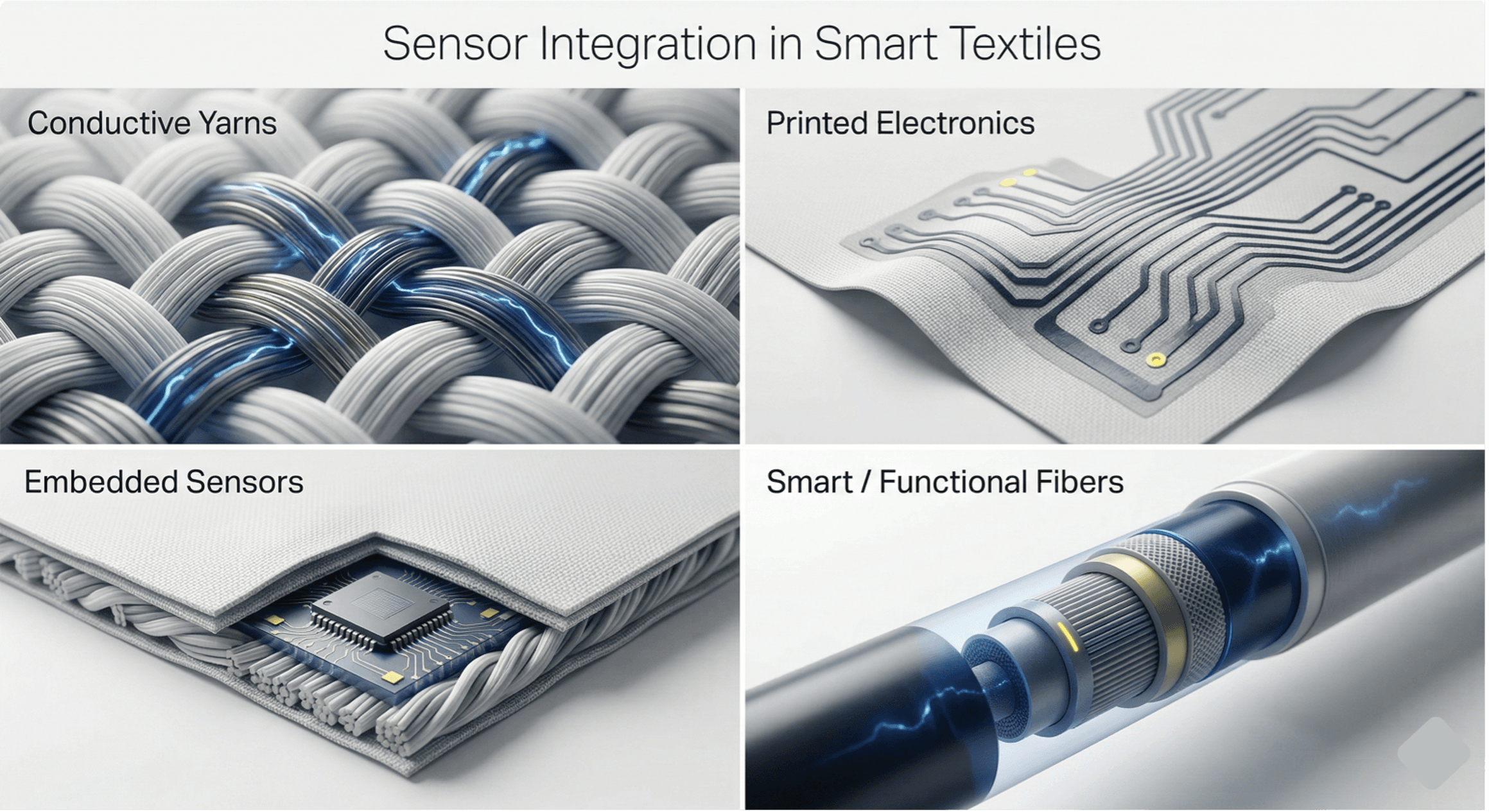
Smart textiles are often described as the future of wearable technology, garments that can sense, analyze, and respond to the human body in real time.
But behind this vision lies a far more complex reality:
The true challenge is not the sensor itself, it’s how you integrate it into the textile.
The Misconception
There is a common assumption that smart textiles are simply traditional garments with sensors “added” to them.
In reality, integration defines everything; *Performance, Durability, Comfort, Scalability. *
Recent research confirms that seamless integration of sensing, actuation, and communication directly into textiles is what differentiates next-generation smart fabrics from conventional wearables [1].
Main Approaches to Sensor Integration
1. Conductive Yarns and Fibers
Embedding sensing capability directly into fibers is one of the most promising approaches. These fibers can function as; strain sensors, temperature sensors & motion detectors.
Recent work demonstrates textile-based capacitive sensing integrated directly into garments, enabling motion capture without rigid components [2].
*Advantages: *High flexibility, Seamless integration
Limitations: Signal variability under deformation, Sensitivity to environmental conditions
2. Printed Electronics on Textiles
This approach uses conductive inks and coatings to create sensing layers on fabric. Advances in nanomaterials and surface treatments have significantly improved the performance of printed textile sensors [3].
*Advantages: *Scalable manufacturing potential, Lightweight and low-profile
*Limitations: *Durability under washing and abrasion, Adhesion challenges
3. Embedded Electronic Components
Miniaturized sensors can be embedded directly into garments to provide accurate measurements. Modern systems combine multiple sensing modalities, such as strain, motion, and bio-signals within textile-based platforms for real-time monitoring [4].
*Advantages: *High precision, Established electronic reliability
*Limitations: *Reduced comfort, Mechanical mismatch with soft textiles
4. Functional and Smart Fibers
The most advanced approach is engineering fibers that inherently possess sensing capabilities. Recent innovations include:
• Nanocomposite-based fibers
• Electrochemical textile sensors for sweat analysis
• Multi-functional sensing textiles
These systems enable detection of physiological markers such as glucose, lactate, and cortisol directly from wearable fabrics [5].
*Advantages: *True textile-native sensing, High integration potential
*Limitations: *Early-stage commercialization, Manufacturing complexity
The Trade-Off Triangle
All integration methods must navigate a fundamental trade-off: Comfort vs Durability vs Performance.
• Improving durability often reduces flexibility
• Enhancing performance may compromise comfort
• Maximizing comfort can limit signal stability
This trade-off remains one of the central challenges highlighted in recent smart textile research [3].
Why Integration Matters? Sensor integration is not just a technical detail, it directly determines:
• Product reliability in real-world conditions
• User adoption, driven by comfort
• Manufacturing scalability, which impacts cost
A major barrier to adoption is still the difficulty of combining textile softness with reliable electronic functionality at scale [2][4].
The Future: Toward Invisible Electronics
The field is rapidly evolving, recent breakthroughs point toward:
• Fully fiber-integrated sensing systems
• Battery-free and wireless textile electronics
• Sustainable and biodegradable smart fabrics
These innovations aim to eliminate rigid components and enable seamless, scalable smart textiles [1][5].
Conclusion
Smart textiles will not be defined by how advanced their sensors are. They will be defined by how seamlessly those sensors disappear into the fabric itself.
References
[1] Ahmed et al. (2025). Smart and Sustainable: A Global Review of Smart Textiles, IoT Integration, and Human-Centric Design.
[2] Geibler et al. (2024). Embedding textile capacitive sensing into smart wearables.
[3] Recent Advances in Textile Materials for Smart Sensor Applications (2025).
[4] Azeem et al. (2024). Design and development of textile-based wearable sensors for biomedical monitoring.
[5] Smart Textile Electrochemical Sensors Review (2023).