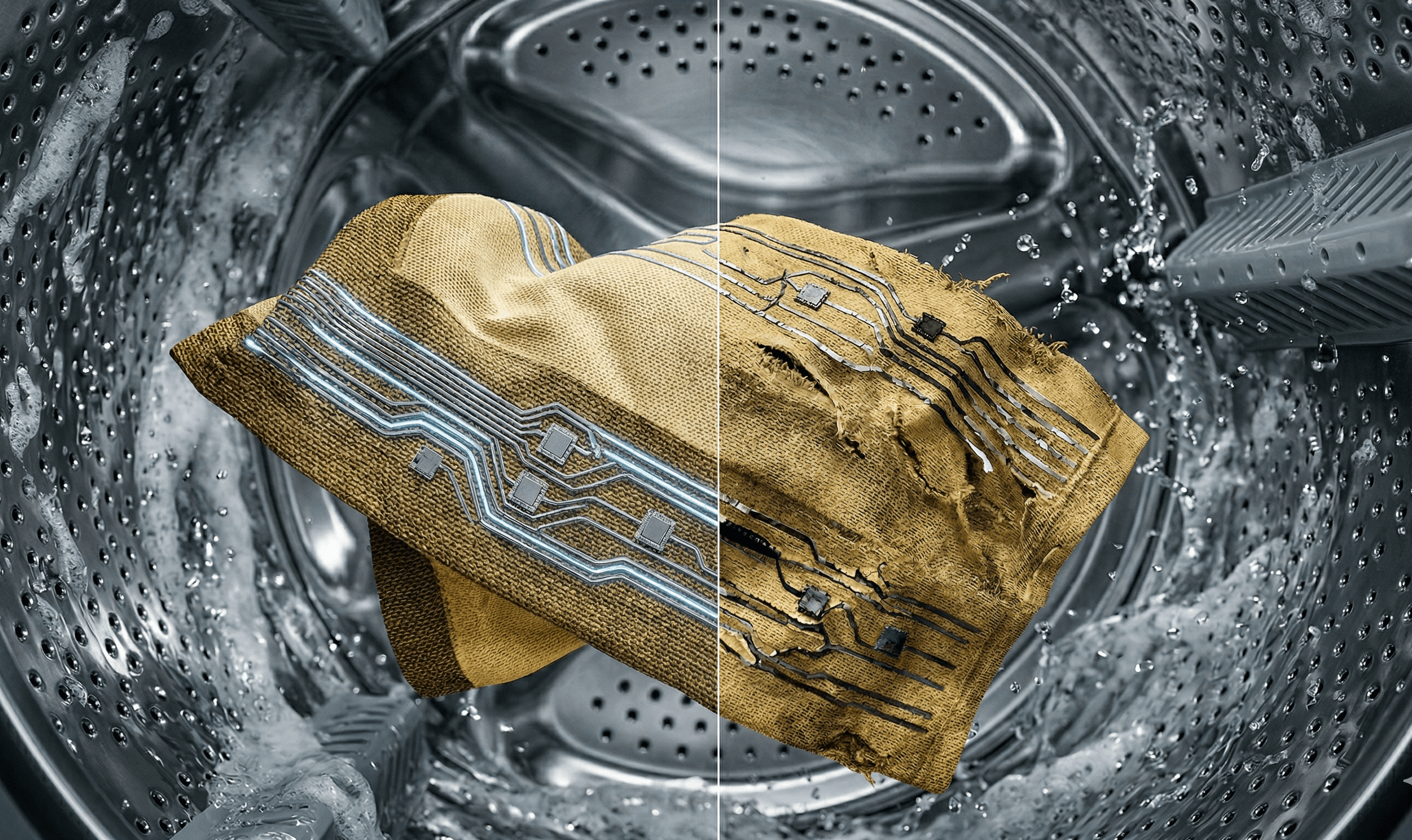
Smart textiles, fabrics embedded with sensors, conductive fibers, and electronic functionality are rapidly reshaping the future of wearable technology. From health-monitoring shirts to temperature-responsive garments, the potential is enormous. However, one critical problem continues to block large-scale adoption: most smart textile products fail after only 30–60 wash cycles.
This is not a minor durability issue; it is one of the main reasons smart textiles struggle to reach mainstream consumers.
1. Washability Is the Core Failure Point
Unlike traditional garments, smart textiles integrate electronic components directly into flexible textile structures, making them highly sensitive to washing conditions such as water, detergents, mechanical agitation, and heat.
Research shows that washability is one of the key performance requirements for commercial smart textile adoption, because without it, products cannot survive real-world use [1].
In practice, a garment that fails after a few dozen washes is considered commercially non-viable, regardless of its sensing performance.
2. Why Washing Destroys Smart Textiles
a. Water and Chemical Degradation
Moisture and detergents can penetrate protective coatings and degrade conductive paths, leading to corrosion and signal loss [2].
b. Mechanical Stress from Washing Machines
Agitation, spinning, and friction introduce repeated bending and tensile forces that damage brittle conductive layers and printed electronics [2].
c. Weak Material Interfaces
Most failures occur at the interface between textile fibers and electronic components, where mismatched elasticity leads to micro-cracks and delamination over time [1].
d. Lack of Smart-Textile-Specific Standards
Current washing standards (like ISO 6330) were designed for traditional textiles, not electronic-integrated fabrics, leading to inconsistent durability expectations [1].
3. Why Failure Often Happens Between 30–60 Washes
The 30–60 wash threshold is not random, it reflects the point where cumulative degradation becomes irreversible.
Common failure mechanisms include:
• Gradual loss of conductive coatings due to abrasion [2]
• Microfractures in printed or coated electronics from repeated bending [1]
• Oxidation and detachment of metallic or conductive layers [2]
• Weak bonding between textile fibers and electronic traces [1]
Over time, these small damages accumulate until the garment can no longer function reliably.
4. Engineering Solutions That Are Changing the Game
a. Advanced Encapsulation Materials
New polymer coatings and flexible encapsulation layers protect electronics from water, detergents, and mechanical stress [2].
b. Fiber-Level Integration
Instead of attaching electronics after fabrication, researchers are embedding conductivity directly into fibers (e.g., core-sheath structures), improving structural resilience [3].
c. Optimized Washing Resistance Design
Engineering efforts now focus on designing for real washing conditions, not lab conditions, including lower temperature resilience and detergent compatibility [2].
d. New Testing Frameworks
Researchers are pushing for updated durability testing standards specifically for smart textiles, since traditional textile testing does not reflect electronic failure modes [1].
5. The Future of Durable Smart Textiles
The future of smart textiles depends on solving one core challenge: integration without fragility.
Progress is being made through:
• Materials innovation (stretchable conductors, nano-coatings)
• Textile-native electronic design
• Real-world durability testing standards
• Cross-disciplinary engineering (textile + electronics + materials science)
Once wash durability matches consumer expectations (100+ cycles), smart textiles will finally transition from prototypes to mainstream products.
References
[1] Stoppa, M. & Chiolerio, A. (2021–2023 updates in smart textile washability research). Washability and durability challenges in electronic textiles: standards and integration limitations.PMC / MDPI Smart Materials and Structures reviews.
[2] Recent review articles on e-textile durability and washing degradation (2022–2024). Effects of laundering on conductive textiles and wearable electronics stability. ScienceDirect – Flexible Electronics & Materials Science Journals.
[3] Zhang, Y. et al. (2023–2025). Fiber-integrated conductive systems for durable smart textiles. Advanced Functional Materials / Nature Electronics-related studies.