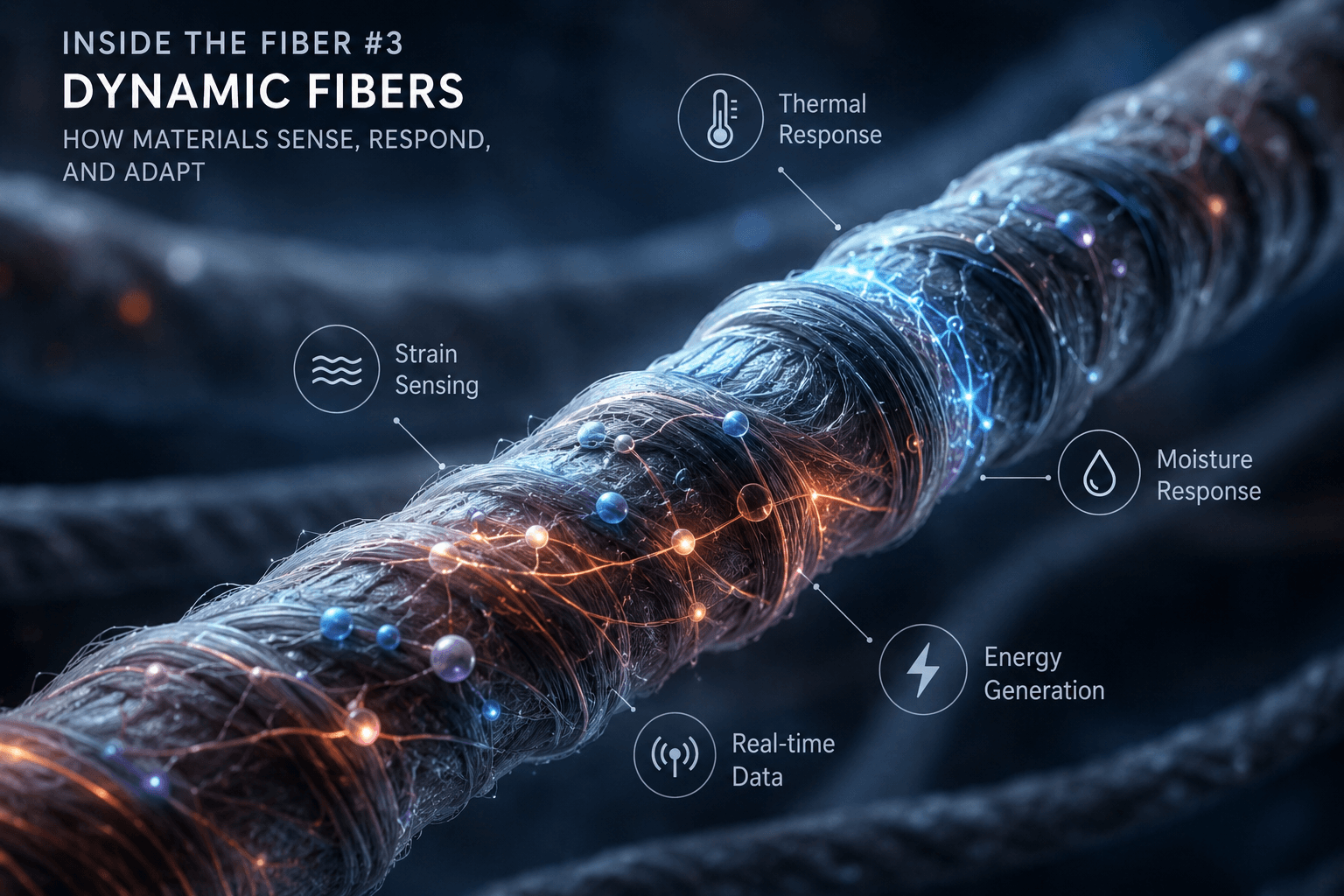
How Materials Begin to Sense, Respond, and Adapt
From static functionality to adaptive material behavior.
For decades, functional fibers were designed around stable performance metrics; strength, conductivity, insulation, elasticity, and durability. Even advanced smart fibers initially focused on embedding fixed functionalities into textile systems. However, the next major transition in fiber engineering is no longer centered on static function, but on dynamic behavior itself. We are entering an era where fibers are engineered to actively respond to their surrounding environment through reversible physical, chemical, thermal, electrical, or mechanical transformations. In this new paradigm, the fiber is no longer a passive functional component. It becomes an adaptive material system capable of sensing, regulating, transforming, and interacting in real time.
Modern dynamic fibers can now:
- Alter conductivity under deformation
- Regulate thermal transport in response to temperature
- Change morphology under external stimuli
- Generate electrical signals from movement
- Reversibly modify permeability, stiffness, or optical behavior
This represents a fundamental shift in textile science. Functionality is no longer fixed inside the material, it becomes conditional, adaptive, and responsive.
1. The Paradigm Shift: From Functional Fibers to Responsive Systems
Traditional fibers are designed to maintain stable properties regardless of environmental variation. Dynamic fibers operate differently. Their behavior is intentionally engineered to change under external stimuli. Recent advances in smart polymer systems, adaptive nanocomposites, and stimuli-responsive materials have enabled fibers that can interact continuously with their environment [1], [2]. These fibers respond to temperature, moisture, strain, pressure, light, pH, electrical fields & biochemical signals. Unlike conventional functional materials, dynamic fibers are governed by reversible state transitions and adaptive internal reorganizations [3]. This changes the role of the fiber entirely. The fiber is no longer simply a material with properties. It becomes an active interface between matter, energy, and information.
2. Mechanisms of Responsiveness: How Fibers Adapt
Dynamic behavior in fibers emerges from carefully engineered molecular and nanoscale mechanisms.
A. Thermoresponsive Systems
Thermoresponsive polymers alter their molecular configuration when exposed to temperature changes. These transitions can modify porosity, flexibility, thermal conductivity, moisture transport, optical appearance.
Phase-change materials (PCMs) are among the most important thermal-responsive systems integrated into fibers today. These materials absorb and release latent heat during phase transitions, enabling passive thermal regulation [4]. Recent research demonstrates that nano-encapsulated PCMs integrated into polymer fibers significantly improve thermal buffering while maintaining flexibility and mechanical integrity [5]. At the fiber level, thermal regulation is no longer achieved only through insulation. The material itself dynamically manages heat flow.
B. Piezoelectric and Mechanoresponsive Fibers
Piezoelectric fibers generate electrical signals under mechanical deformation. This allows textiles to convert motion, pressure, and strain into measurable electrical outputs [6]. Modern piezoelectric polymer systems based on PVDF and related copolymers have enabled motion sensing, biomechanical monitoring, pressure mapping & energy harvesting. Simultaneously, conductive nanocomposite fibers exhibit mechanoresponsive behavior where resistance changes dynamically during stretching or bending [7]. In these systems, mechanical deformation becomes a source of real-time information.
C. Moisture-Responsive and Hygroscopic Fibers
Bio-inspired moisture-responsive materials can reversibly expand, contract, or bend depending on humidity levels [8]. These fibers mimic natural systems such as pinecones or plant tissues where anisotropic swelling drives movement.
Advanced hygromorphic fibers now demonstrate:
- Self-ventilating textile structures
- Adaptive breathability
- Moisture-triggered actuation
This introduces a new design principle where the environment itself becomes part of the functional control system.
3. Adaptive Networks and Dynamic Interphases
In traditional polymer composites, filler networks are often considered static after fabrication. However, recent studies show that conductive and functional networks inside dynamic fibers continuously evolve during deformation and environmental exposure [9].
Under strain, temperature variation, or cyclic loading:
- conductive pathways reorganize
- tunneling distances shift
- interphase mobility changes
- local polymer confinement evolves
These dynamic internal rearrangements directly influence conductivity, sensing accuracy, mechanical stability & thermal transport behavior.
This reveals an important principle in modern fiber engineering. Functionality is not only determined by structure, but by the ability of structure to evolve dynamically during use. The interphase region between polymer matrix and nanofillers becomes especially critical. Recent research highlights that adaptive interphases regulate charge transfer, stress dissipation, and reversible conductivity changes under repeated deformation [10]. In dynamic fibers, the interphase is no longer a static boundary. It becomes an active functional domain.
4. Fibers as Real-Time Information Systems
One of the most transformative developments in smart textile engineering is the emergence of fibers capable of continuously sensing and transmitting information across textile structures. Recent wearable systems demonstrate fibers that can:
- monitor physiological motion
- track respiration
- detect pressure distribution
- sense thermal fluctuations
- map strain continuously across fabrics [11]
Unlike rigid electronics, fiber-based sensing systems distribute intelligence throughout the textile architecture itself that enables greater flexibility, reduced wiring complexity, improved comfort & scalable manufacturing integration. In this framework, the textile is no longer a passive substrate carrying electronics, the textile itself becomes the sensing system, where fiber evolves into a sensor an actuator, an energy interface, a communication pathway, a responsive structural element, simultaneously.
5. The Scientific Challenge: Stability vs Adaptability
Despite rapid advances, dynamic fibers face a fundamental engineering challenge:
How do we design materials that remain mechanically stable while continuously changing their internal functional state? Adaptive systems inherently involve competing effects:
- increased molecular mobility improves responsiveness but weakens structural stability
- dynamic conductive networks improve sensing but reduce long-term reliability
- reversible phase transitions enable adaptation but accelerate fatigue
- soft responsive domains improve actuation but complicate processing
Maintaining reversibility over thousands of mechanical and thermal cycles remains one of the most difficult problems in smart fiber engineering [12].
Key challenges include:
- hysteresis control
- cyclic degradation
- interfacial fatigue
- signal drift
- response speed
- energy efficiency
- scalable manufacturability
This is where polymer science, nanotechnology, and systems engineering converge.
Conclusion
Dynamic fibers represent the next major evolution in material engineering, where functionality is no longer fixed, but adaptive, responsive, and continuously interactive.
At the molecular and nanoscale levels:
- polymers reorganize
- conductive pathways evolve
- interphases adapt
- material states transition dynamically
In this new generation of fibers:
- heat becomes information
- deformation becomes signal
- moisture becomes activation
- movement becomes energy
The fiber is no longer simply engineered to perform a function. It is engineered to change its behavior in response to the world around it.
The future of advanced textiles will not be defined only by stronger materials or better conductivity.
It will be defined by materials that can sense, respond, adapt, and interact as living systems of functionality.
References
[1] Chen et al., Smart Fibers and Textiles: From Advanced Functional Materials to Wearable Sensing Devices, Advanced Materials, 2021.
[2] Zhu et al., Functional and Smart Fiber Innovations for Wearable Electronics, National Science Review, 2024.
[3] Li et al., Stimuli-Responsive Fibers and Textiles for Smart Wearable Applications, Advanced Fiber Materials, 2022.
[4] Mondal, Phase Change Materials for Smart Textiles, Applied Thermal Engineering, 2018.
[5] Salaün et al., Microencapsulated Phase Change Materials in Textile Applications, Materials Today Sustainability, 2021.
[6] Wang et al., Piezoelectric Polymer Nanofibers for Wearable Electronics, Nano Energy, 2020.
[7] Liu et al., Stretchable Conductive Fibers for Smart Textiles, Advanced Functional Materials, 2023.
[8] Erb et al., Bioinspired Hygromorphic Materials and Structures, Nature Reviews Materials, 2021.
[9] Cao et al., Dynamic Percolation Networks in Functional Polymer Nanocomposites, Journal of Applied Physics, 2020.
[10] Jamirad et al., Interfacial Thermal and Electrical Transport in Nanocomposites, ACS Applied Materials & Interfaces, 2023.
[11] Lu et al., Functional Fibers for Smart Sensing Devices and Healthcare Applications, Analytical Methods, 2024.
[12] Xu et al., Durability Challenges in Wearable Smart Textiles, Advanced Intelligent Systems, 2022.