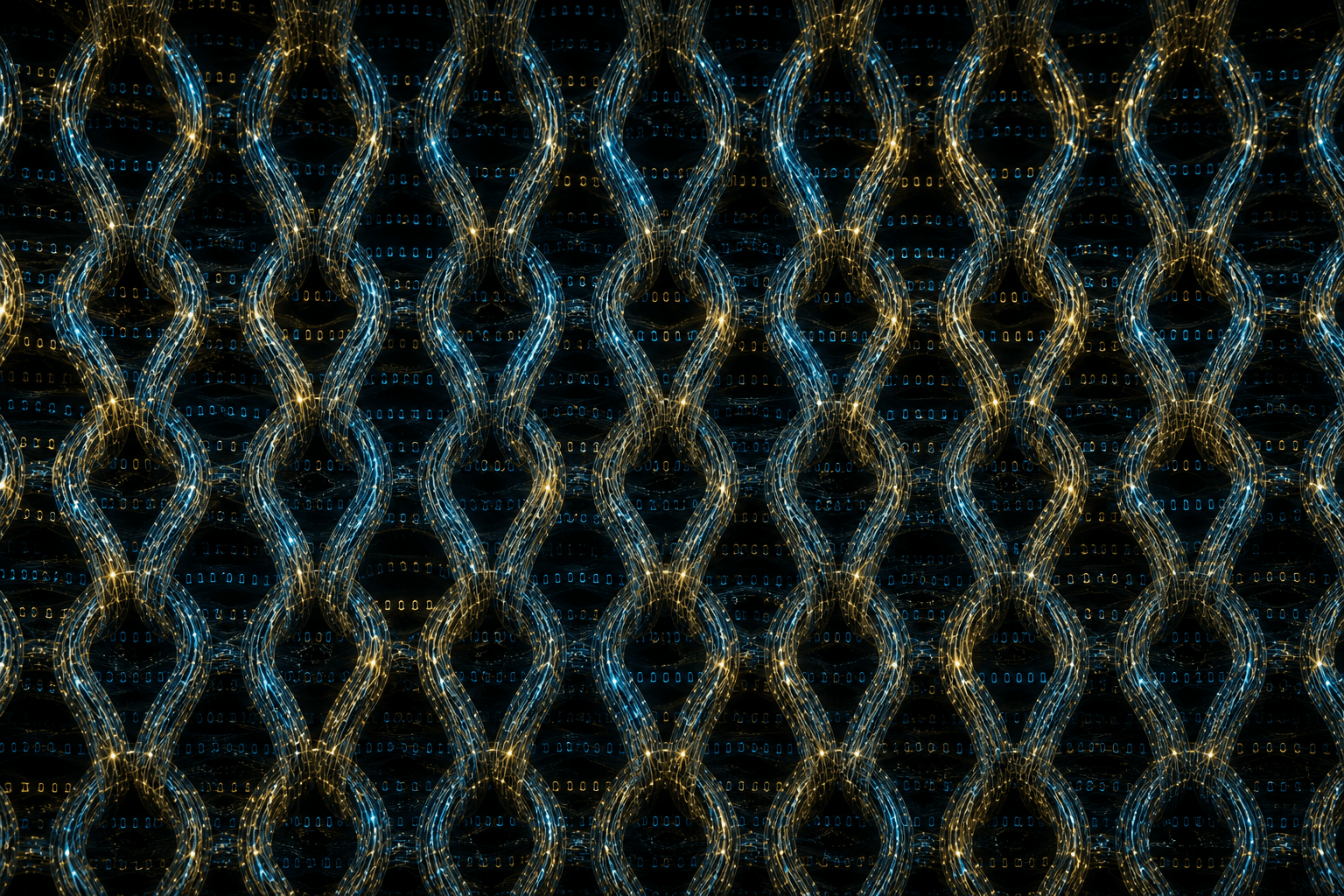
When Fibers Become Networks
*From individual information pathways to collective material intelligence. *
Throughout the history of materials engineering, intelligence has existed outside the material itself. Sensors collected data, processors analyzed information, and external control systems generated responses. Materials served as passive platforms that supported these functions but rarely participated in them.Recent advances in fiber engineering are beginning to challenge this distinction. As fibers become capable of sensing, generating information, and communicating signals, a new question emerges:
What happens when thousands of intelligent fibers interact simultaneously within a textile structure?
The answer is distributed intelligence.In distributed intelligent systems, functionality no longer resides within a single component. Instead, intelligence emerges from interactions between many interconnected elements operating collectively. This concept is already familiar in biological systems. Human skin contains millions of distributed sensing receptors rather than a single sensor. Neural networks derive intelligence from interconnected nodes rather than isolated processors. Similarly, future fiber systems may derive intelligence from the collective behavior of interconnected fibers rather than individual sensing elements alone [1,2]. The textile is no longer simply composed of intelligent fibers. The textile itself becomes an intelligent system.
1. The Paradigm Shift: From Smart Fibers to Intelligent Networks
Much of today's smart textile development focuses on enhancing individual fibers with sensing, conductive, or responsive capabilities. While these advancements are important, they represent only the first stage of evolution. A single sensing fiber can provide information about a localized event. An interconnected network of fibers can identify patterns, relationships, and spatial distributions that cannot be observed by individual sensing points alone [3]. This distinction mirrors the difference between isolated neurons and a functioning nervous system. Intelligence does not arise from individual components. It emerges from the interactions between them. Recent developments in distributed sensing architectures demonstrate how networks of fibers can monitor deformation, temperature, pressure, movement, and physiological activity across large textile surfaces [4]. In these systems, the collective network becomes more valuable than any individual fiber. The engineering challenge shifts from designing better fibers to designing better interactions between fibers.
2. How Intelligence Emerges from Networks
Distributed intelligence is fundamentally an emergent phenomenon.Emergent systems exhibit behaviors that cannot be predicted solely by examining individual components. Instead, functionality arises from collective interactions across the network. Within fiber systems, these interactions may occur through electrical pathways, optical communication channels, ionic transport mechanisms, mechanical coupling, or hybrid architectures that combine multiple forms of signal transfer [5]. As information propagates through these interconnected pathways, the system becomes capable of recognizing patterns rather than merely recording events. A localized pressure change may become part of a larger movement pattern. A temperature variation may become part of a broader thermal map. Multiple sensing events can combine to reveal complex behaviors that isolated measurements cannot detect. This transition represents a critical threshold in fiber engineering. The goal is no longer simply sensing. The goal becomes interpretation.
3. Textile Architectures as Distributed Sensing Platforms
One of the most promising applications of distributed intelligence is the transformation of entire textile structures into sensing platforms. Traditional sensing systems often rely on discrete sensors positioned at specific locations. This approach creates gaps between measurement points and limits spatial resolution. Distributed fiber networks overcome this limitation by embedding sensing functionality throughout the material itself [6]. Recent research demonstrates textile systems capable of continuously mapping pressure distribution, body movement, structural deformation, and environmental conditions across large surfaces. Instead of monitoring isolated points, these systems create continuous information fields throughout the textile architecture [7]. This capability enables a fundamentally different approach to data acquisition. The textile no longer asks whether a specific event occurred. The textile understands where it occurred, how it evolved, and how it relates to surrounding conditions. Information becomes spatially aware.
4. Learning Materials and Adaptive Networks
As distributed sensing networks become more sophisticated, researchers are increasingly exploring systems capable of adaptive behavior. Adaptive networks modify their responses based on previous inputs, environmental conditions, or evolving operational requirements. While most current fiber systems remain dependent on external computation, emerging research suggests that aspects of adaptation can be integrated directly into material architectures themselves [8]. Examples include conductive networks that reorganize under repeated deformation, neuromorphic fiber systems that mimic biological signal processing, and programmable materials that alter functionality based on stimulus history [9]. These developments suggest a future in which fibers do not merely detect environmental changes. They begin to adjust their behavior in response to those changes. The distinction between sensing and decision-making becomes increasingly blurred.
5. The Convergence of Materials Science and Information Science
Historically, materials science focused on controlling matter. Information science focused on controlling data. Distributed intelligent fibers represent a convergence of these disciplines. Modern fiber systems are increasingly designed around the simultaneous management of material structure, energy transport, information flow & adaptive response.
In such systems, information pathways become as important as mechanical reinforcement pathways. Signal propagation becomes as critical as thermal conductivity. Network architecture becomes as significant as polymer chemistry [10]. This convergence is creating entirely new engineering challenges that extend beyond traditional materials development. Future fiber engineers may need to understand not only polymers and nanocomposites, but also communication theory, network behavior, computational systems, and information architecture. The fiber is becoming a multidisciplinary engineering platform.
6. The Scientific Challenge: Scaling Intelligence
Despite remarkable progress, significant barriers remain before truly intelligent textile systems become widespread. Distributed networks generate enormous volumes of information. Managing signal quality, minimizing noise, maintaining network reliability, and ensuring long-term durability remain major challenges [11]. Mechanical deformation introduces variability into signal transmission. Environmental exposure can alter network performance. Manufacturing large-scale intelligent fiber systems requires precise control over architecture across multiple length scales. Furthermore, intelligence itself introduces complexity. The more adaptive a system becomes, the more difficult it becomes to predict, model, and optimize its behavior. The challenge is no longer merely creating intelligent fibers. The challenge is creating intelligent systems that remain reliable, scalable, and manufacturable.
Conclusion
The evolution of fibers is no longer defined solely by improvements in strength, conductivity, or responsiveness. A new generation of materials is emerging in which intelligence arises from networks of interacting fibers capable of sensing, communicating, and adapting collectively. Through advances in distributed sensing, network architectures, adaptive materials, and information-driven design, fibers are evolving beyond individual functional elements into interconnected systems of intelligence.
In this new paradigm: Individual fibers generate information. Networks create understanding. Architecture creates intelligence. The future of advanced textiles may not be built around devices embedded within fabrics. It may be built around fabrics that become devices themselves. The fiber is no longer merely a structural component. It is becoming part of an intelligent network woven directly into the material world.
References
[1] Chen et al., Functional Fiber Materials to Smart Fiber Devices, Chemical Reviews, 2022.
[2] Zhu, Functional and Smart Fiber Innovations for Wearable Electronics, National Science Review, 2024.
[3] Lu et al., Functional Fibers and Textiles for Smart Sensing Applications, Analytical Methods, 2024.
[4] Hannigan et al., Distributed Sensing Along Fibers for Smart Materials and Structures, Advanced Intelligent Systems, 2024.
[5] Zhang et al., Fiber Electronics and Intelligent Fiber Systems, Nature Electronics, 2022
[6] Heo et al., Distributed Fiber-Based Sensing Architectures for Wearable Systems, Advanced Functional Materials, 2023.
[7] Shi et al., Textile-Based Distributed Sensing Systems for Human Monitoring, Advanced Science, 2024.
[8] Wang et al., Adaptive and Neuromorphic Fiber Systems, Advanced Materials Technologies, 2023.
[9] Kim et al., Programmable Fiber Electronics and Intelligent Textiles, Nano Energy, 2024.
[10] Liu et al., Multifunctional Nanocomposite Fibers: Design and Applications, Advanced Fiber Materials, 2023.
[11] Xu et al., Reliability and Durability Challenges in Smart Fiber Systems, Advanced Intelligent Systems, 2022.