How Fibers Harvest, Store, and Manage Energy
From information systems to self-powered material platforms.
Throughout the evolution of advanced fibers, functionality has progressively moved inward. Mechanical performance became engineered at the molecular level. Conductivity became embedded within polymer architectures. Sensing capabilities became integrated directly into fiber structures. More recently, fibers have begun to generate information, communicate signals, and participate in distributed intelligent networks. Yet a fundamental challenge remains. Every sensing event, every transmitted signal, every adaptive response requires energy. Historically, energy has been supplied to textile systems through external sources such as batteries, electronic modules, wired power systems, or attached devices. As fibers become increasingly intelligent and multifunctional, dependence on external energy sources becomes a major limitation. Batteries introduce rigidity, weight, maintenance requirements, and design constraints that conflict with the flexibility and scalability of textile systems. As a result, researchers are pursuing a new objective: To transform the fiber itself into an energy platform.
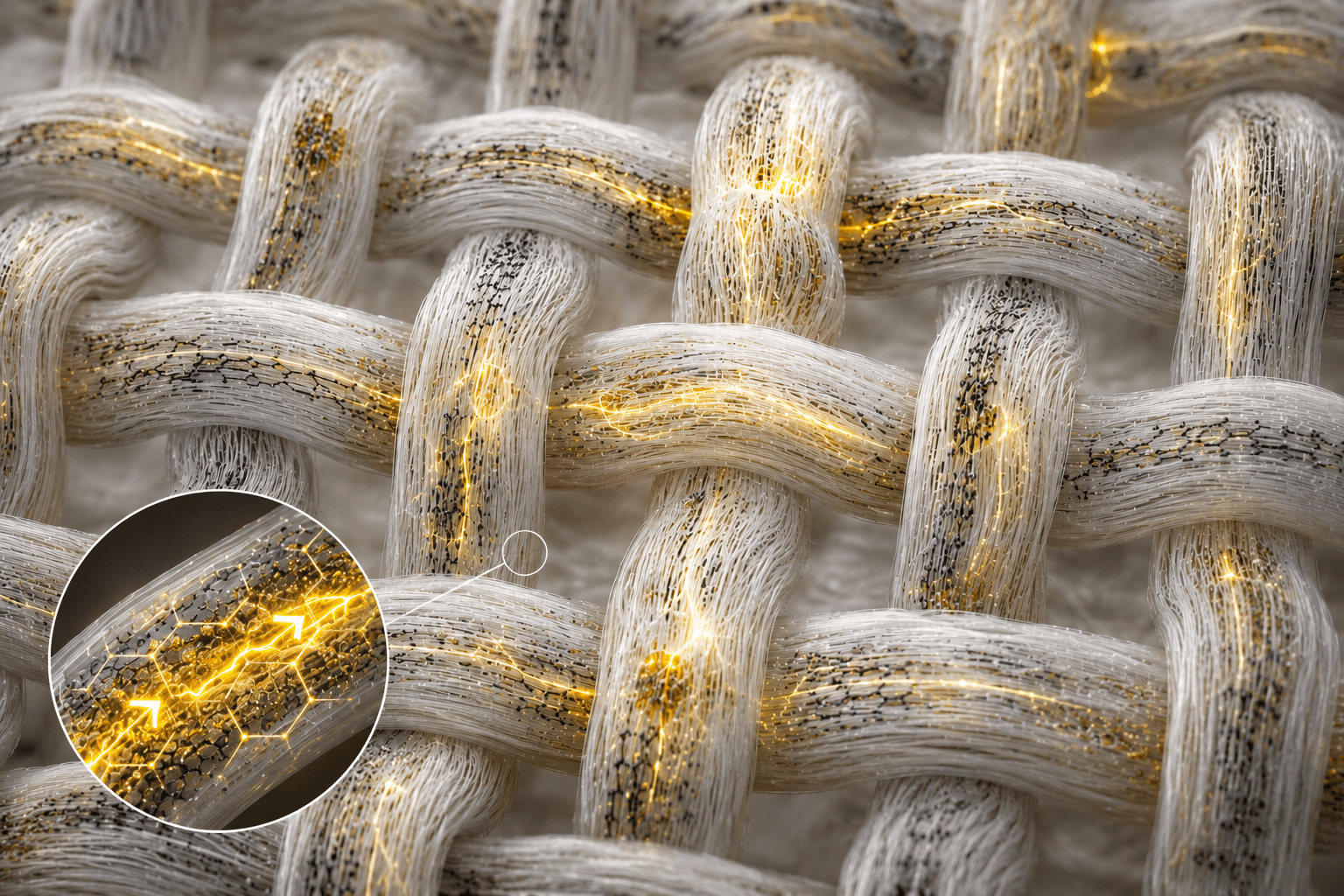
Modern fibers are increasingly being engineered to harvest energy from their surroundings, store energy within their internal structures, and regulate energy flow throughout the material system. In this emerging paradigm, the fiber is no longer simply a consumer of energy. It becomes an active participant in energy generation and management [1,2].
1. The Paradigm Shift: Energy as a Material Function
For most of textile history, energy existed outside the material.
Fibers provided structure, comfort, protection, and functionality, while energy was supplied through external devices. This separation has become increasingly problematic as smart textiles evolve toward distributed sensing, wearable electronics, and adaptive systems. Recent developments in nanomaterials, conductive polymers, fiber electronics, and multifunctional composites are enabling a different approach. Energy-related functions can now be integrated directly into fiber architectures themselves [3]. Instead of viewing energy as an external resource delivered to the textile, researchers are beginning to treat energy as an intrinsic material function. This shift mirrors earlier transitions in conductivity, sensing, and responsiveness. Just as information became embedded within fibers, energy is increasingly becoming embedded within the material architecture. The result is the emergence of fibers that can simultaneously perform structural, sensing, communication, and energy-related functions.
2. Harvesting Energy from the Environment
One of the most active areas of research in intelligent textiles involves harvesting energy from ambient sources that already exist in the environment. Human motion, body heat, mechanical deformation, vibration, sunlight, and environmental temperature gradients all represent potential sources of usable energy [4]. Among the most widely studied systems are piezoelectric fibers, which generate electrical signals when subjected to mechanical stress. As fibers bend, stretch, compress, or vibrate, internal dipole structures produce electrical outputs that can be harvested and utilized by nearby systems [5]. Triboelectric fibers offer a related mechanism. These materials generate charge through repeated contact and separation between surfaces. Everyday activities such as walking, running, bending, or fabric movement can therefore become sources of electrical energy [6]. Thermoelectric fibers provide another pathway by converting temperature differences into electrical power. Because the human body continuously produces heat, thermoelectric systems offer a particularly attractive route toward self-powered wearable technologies [7]. In each case, energy is not delivered to the fiber. Energy emerges from interactions between the fiber and its environment.
3. Energy Storage Within Fiber Architectures
Harvesting energy alone is insufficient. Practical systems must also store energy in a stable and accessible form. Traditionally, energy storage has relied on rigid batteries that are difficult to integrate into flexible textile systems. Recent advances are enabling the development of fiber-shaped energy storage devices that preserve flexibility while providing electrical capacity [8]. Researchers have developed fiber-based supercapacitors, flexible batteries, and hybrid energy storage architectures capable of being woven directly into textile structures. Conductive polymers, carbon nanotubes, graphene derivatives, and advanced nanocomposite materials have emerged as key components within these systems [9]. Unlike conventional batteries that exist separately from the textile, these architectures integrate storage directly into the material itself. The distinction between fiber and energy device begins to disappear. A yarn can simultaneously provide mechanical strength, electrical conductivity, sensing capability, and energy storage. This convergence represents a major step toward fully integrated textile systems.
4. Energy Transport Through Fiber Networks
Generating and storing energy solves only part of the problem. Energy must also move efficiently throughout the textile architecture. Within intelligent fiber systems, energy transport increasingly resembles information transport. Conductive pathways, percolation networks, interphase engineering, and nanoscale connectivity all influence the movement of charge through the material [10]. Recent research demonstrates that conductive fiber networks can function as distributed energy pathways capable of transferring power across textile structures while maintaining flexibility and mechanical performance [11]. The architecture of these networks becomes critically important. Poor connectivity increases resistance and energy loss. Optimized network structures improve charge transport, enhance reliability, and reduce power requirements. This highlights an important principle: Energy management is no longer solely an electrical engineering problem. It is fundamentally a materials engineering problem.
5. Toward Self-Powered Intelligent Textiles
The convergence of energy harvesting, storage, transport, sensing, and communication is giving rise to a new class of systems often described as self-powered intelligent textiles. These systems seek to eliminate dependence on external power sources by generating and managing energy directly within the textile architecture [12]. Recent prototypes have demonstrated garments capable of simultaneously monitoring movement, harvesting biomechanical energy, storing electrical charge, and powering low-energy sensing systems. While many of these technologies remain under development, they illustrate the direction in which fiber engineering is moving. The long-term objective is not merely to create textiles that contain energy devices. The objective is to create textiles that function as energy systems. In this vision, energy generation, storage, sensing, and communication become integrated aspects of a unified material architecture.
6. The Scientific Challenge: Balancing Energy and Function
Despite remarkable advances, significant challenges remain. Energy harvesting systems often produce relatively small amounts of power. Energy storage materials must balance capacity with flexibility. Conductive pathways must maintain performance under repeated mechanical deformation. Furthermore, integrating multiple energy functions into a single fiber can introduce competing requirements [13]. Materials optimized for conductivity may compromise mechanical durability. Systems designed for high energy storage may reduce flexibility. Energy harvesting architectures may introduce manufacturing complexity or increase production costs. Engineers therefore face a multi-dimensional optimization challenge involving energy density, mechanical performance, durability, processability, scalability & user comfort. Successfully balancing these factors remains one of the most important frontiers in advanced fiber engineering.
Conclusion
As fibers evolve from structural materials into intelligent systems, energy becomes a fundamental design consideration. The ability to harvest, store, transport, and regulate energy directly within fiber architectures represents a major step toward truly autonomous textile systems. Through advances in conductive polymers, nanocomposite materials, fiber electronics, energy harvesting technologies, and integrated storage architectures, energy is becoming embedded within the material itself. The fiber is no longer simply a pathway for force, heat, or information. It is becoming an energy platform. And as energy moves inside the fiber, the boundaries separating materials, electronics, and power systems continue to dissolve. The future of intelligent textiles may not depend on external batteries. It may depend on fibers that power themselves.
References
[1] Chen et al., Functional Fiber Materials to Smart Fiber Devices, Chemical Reviews, 2022.
[2] Zhu, Functional and Smart Fiber Innovations for Wearable Electronics, National Science Review, 2024.
[3] Zhang et al., Fiber Electronics: Materials, Devices, and Integrated Systems, Nature Electronics, 2022.
[4] Wang et al., Energy Harvesting Technologies for Wearable Systems, Advanced Functional Materials, 2023.
[5] Kim et al., Piezoelectric Fiber Systems for Wearable Energy Generation, Nano Energy, 2023.
[6] Fan et al., Triboelectric Textile Systems for Self-Powered Wearable Electronics, Advanced Energy Materials, 2022.
[7] He et al., Thermoelectric Fibers for Wearable Energy Harvesting, Advanced Materials Technologies, 2024.
[8] Liu et al., Fiber-Shaped Energy Storage Devices: Recent Advances and Challenges, Advanced Fiber Materials, 2023.
[9] Xu et al., Flexible Fiber-Based Supercapacitors and Batteries, Energy Storage Materials, 2022.
[10] Jamirad et al., Interfacial Transport Phenomena in Functional Nanocomposites, ACS Applied Materials & Interfaces, 2023.
[11] Shi et al., Conductive Fiber Networks for Distributed Energy Transport, Advanced Science, 2024.
[12] Lu et al., Self-Powered Smart Textile Systems for Wearable Applications, Analytical Methods, 2024.
[13] Zhao et al., Challenges and Opportunities in Fiber-Based Energy Systems, Advanced Intelligent Systems, 2023.