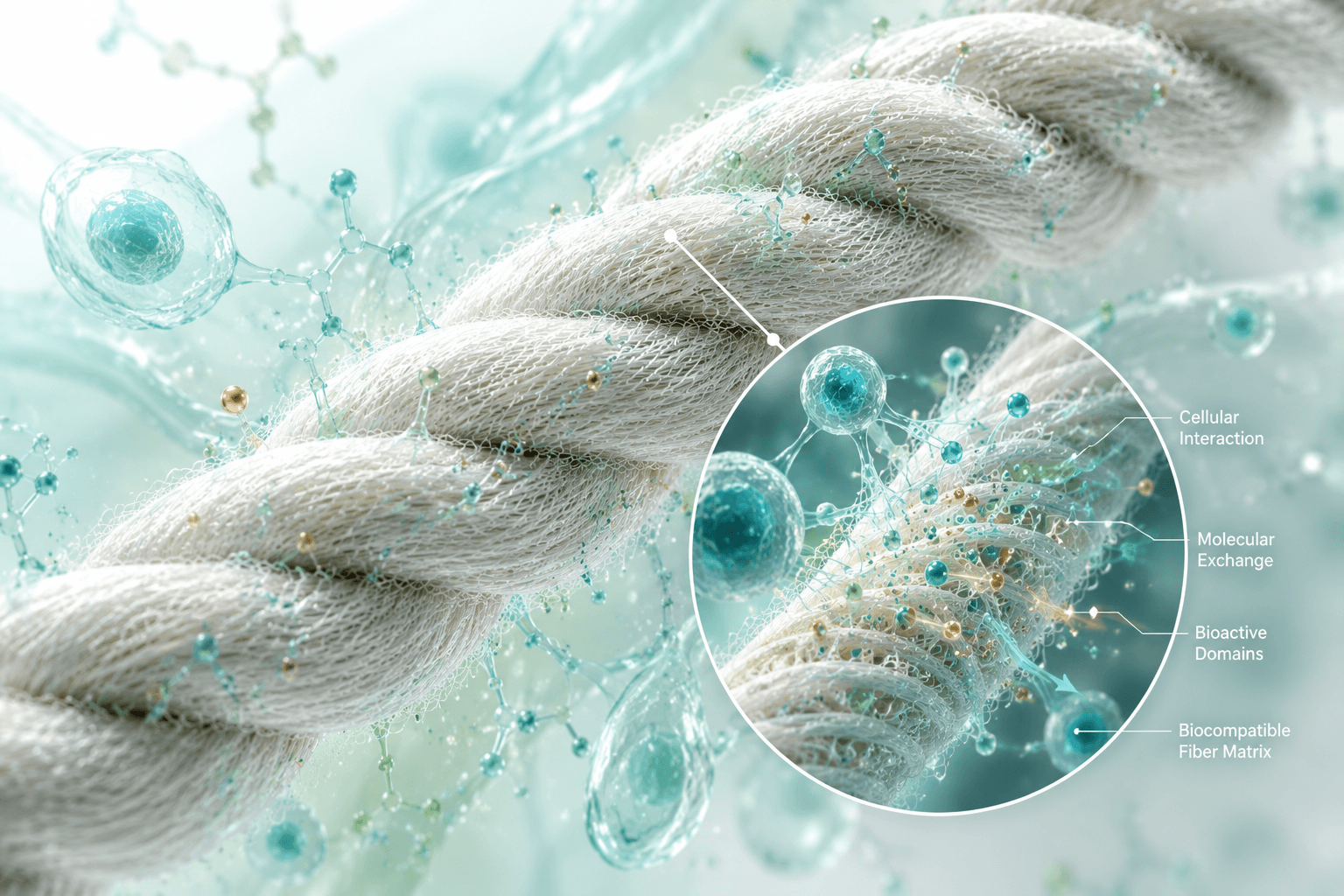
From intelligent materials to biologically integrated systems.
For most of human history, textiles have served as passive interfaces between the body and the surrounding environment. Fibers provided protection, comfort, insulation, durability, and aesthetics, but remained fundamentally separate from the biological systems they surrounded. Even the most advanced functional textiles traditionally operated as external tools. They managed moisture, regulated temperature, improved mechanical performance, or provided protection, yet they remained disconnected from the physiological processes occurring beneath the skin.
Today, this distinction is beginning to disappear. Recent advances in polymer science, biomaterials engineering, nanotechnology, and fiber-based sensing systems are enabling the development of bioactive fibers; materials specifically engineered to interact with biological environments through chemical, physical, electrical, or biochemical mechanisms [1,2]. These fibers do not simply coexist with the body. They communicate with it. In this emerging paradigm, the fiber is no longer merely a structural material or intelligent device. It becomes a biologically integrated platform capable of sensing physiological conditions, responding to biological signals, influencing cellular environments, and participating in human-centered material systems. This marks the beginning of a new chapter in fiber engineering: The convergence of materials science and biology.
1. The Paradigm Shift: From Human-Worn to Human-Integrated
Traditional textile engineering focused on creating materials that perform around the human body. Bioactive fibers are designed to perform with the human body. This distinction may appear subtle, but it represents a profound transformation in material design philosophy. Historically, textile functionality was evaluated through parameters such as mechanical durability, thermal insulation, moisture transport, and comfort. In bioactive systems, functionality increasingly includes physiological interaction. The material itself becomes capable of detecting biological signals, influencing biological responses, or adapting according to physiological conditions [3]. As a result, fibers are beginning to function as dynamic interfaces between engineered systems and living systems. The goal is no longer simply improving material performance. The goal is enabling material-biological interaction.
2. Biological Signals as Material Inputs
The human body continuously generates information. Temperature fluctuations, perspiration, movement, pressure, respiration, biochemical markers, electrical activity, and metabolic processes all produce measurable physiological signals. Recent advances in fiber-based sensing technologies have demonstrated the ability to detect many of these signals directly within textile structures [4]. Conductive fibers can monitor biomechanical movement through resistance changes. Thermally responsive systems can detect variations in skin temperature. Electroactive materials can respond to electrophysiological signals generated by muscles or other biological systems. Increasingly, researchers are also developing fibers capable of detecting chemical biomarkers present in sweat, interstitial fluids, and localized biological environments [5]. In these systems, biology becomes an information source. The fiber becomes a physiological interface.
3. Bioactive Materials and Biological Response
Perhaps the most transformative aspect of bioactive fibers lies not in sensing biology, but in influencing it. Modern biomaterial research increasingly focuses on materials capable of interacting with cells, tissues, and biological processes in controlled ways [6]. Bioactive polymers, engineered surfaces, functional nanoparticles, and biologically responsive additives can influence biological environments through mechanisms such as:
• controlled molecular release
• antimicrobial activity
• cellular interaction
• tissue compatibility
• biochemical responsiveness
Rather than functioning solely as structural materials, these fibers become active participants in biological systems. This capability has significant implications for healthcare, wound management, rehabilitation, performance monitoring, and therapeutic textiles.
The material is no longer simply observing biology. It is interacting with biology.
4. The Fiber as a Physiological Communication Platform
As discussed in previous articles, fibers are increasingly capable of generating information, transporting signals, and participating in distributed intelligent networks. When these capabilities are combined with biological sensing, the fiber evolves into a physiological communication platform. Recent research demonstrates textile systems capable of continuously monitoring human motion, respiratory patterns, cardiovascular activity, and localized physiological conditions without the need for rigid electronic devices [7].
The significance of these developments extends beyond wearable technology. Traditional healthcare monitoring often occurs periodically and within controlled environments. Fiber-based systems create the possibility of continuous physiological observation integrated directly into everyday materials. The textile becomes part of the information pathway between biology and technology.
5. Bioinspired Fibers: Learning from Living Systems
Biology not only provides signals for fibers to detect. It also provides design principles. Many of the most advanced fiber architectures being developed today draw inspiration from biological systems that have evolved over millions of years. Natural materials demonstrate extraordinary capabilities in sensing, adaptation, self-regulation, energy management, and structural optimization [8].
Researchers increasingly study biological mechanisms such as:
• skin-based sensing
• vascular transport networks
• hierarchical structural organization
• adaptive cellular architectures
• self-healing mechanisms
These biological strategies are being translated into synthetic fiber systems capable of exhibiting similar functional behaviors. In this sense, bioactive fibers are not simply interacting with biology. They are learning from biology.
6. Toward Therapeutic and Regenerative Textiles
One of the most exciting frontiers in bioactive fiber engineering involves therapeutic functionality. Emerging fiber systems are being developed to move beyond monitoring and toward active biological intervention.
Examples include materials capable of:
• supporting wound healing
• delivering therapeutic compounds
• providing antimicrobial protection
• stimulating tissue regeneration
• enhancing physiological recovery
Advanced biomaterials can create localized environments that encourage specific biological responses while maintaining the flexibility and comfort expected from textile systems [9]. Although many of these technologies remain in developmental stages, they demonstrate how fibers may evolve from diagnostic tools into therapeutic platforms. The textile becomes more than a passive layer between the body and the environment. It becomes an active participant in health management.
7. The Scientific Challenge: Engineering Compatibility with Life
Despite tremendous progress, bioactive fibers face unique scientific challenges. Unlike conventional engineering materials, biological systems are highly dynamic, adaptive, and variable. Materials designed for biological interaction must maintain performance while accommodating:
• biochemical complexity
• physiological variability
• long-term biocompatibility
• environmental exposure
• mechanical deformation
Additionally, bioactive systems must balance functionality with safety, durability, comfort, manufacturability, and regulatory requirements [10].
Creating materials that interact effectively with biological systems while remaining scalable and commercially viable remains one of the most complex challenges in modern materials engineering. This challenge sits at the intersection of polymer science, biology, medicine, chemistry, and systems engineering.
Conclusion
The evolution of fibers is increasingly moving beyond mechanics, energy, information, and intelligence. It is moving toward biology. Through advances in biomaterials, physiological sensing, bioactive polymers, therapeutic systems, and biologically integrated architectures, fibers are becoming capable of interacting directly with living systems in ways that were previously unimaginable. The future of advanced textiles may not be defined solely by how materials protect the body. It may be defined by how materials communicate with it, adapt to it, and ultimately support it.
In this new paradigm:
The body becomes part of the system, The fiber becomes part of the biology & the boundary between living systems and engineered materials continues to fade.
References
[1] Chen et al., Functional Fiber Materials to Smart Fiber Devices, Chemical Reviews, 2022.
[2] Zhu, Functional and Smart Fiber Innovations for Wearable Electronics and Healthcare Systems, National Science Review, 2024.
[3] Stoppa & Chiolerio, Wearable Electronics and Smart Textiles: A Critical Review, Sensors, updated developments through 2021–2024.
[4] Lu et al., Functional Fibers and Textiles for Smart Sensing Devices and Personal Healthcare Applications, Analytical Methods, 2024.
[5] Gao et al., Wearable Biosensors for Continuous Physiological Monitoring, Nature Reviews Bioengineering, 2023.
[6] Wang et al., Bioactive Polymer Systems for Biomedical Applications, Advanced Functional Materials, 2022.
[7] Shi et al., Textile-Based Physiological Monitoring Systems, Advanced Science, 2024.
[8] Erb et al., Bioinspired Materials and Adaptive Systems, Nature Reviews Materials, 2021.
[9] Li et al., Therapeutic Fibers and Regenerative Textile Systems, Advanced Healthcare Materials, 2023.
[10] He et al., Challenges and Opportunities in Bioactive Textile Engineering, Advanced Materials Technologies, 2024.