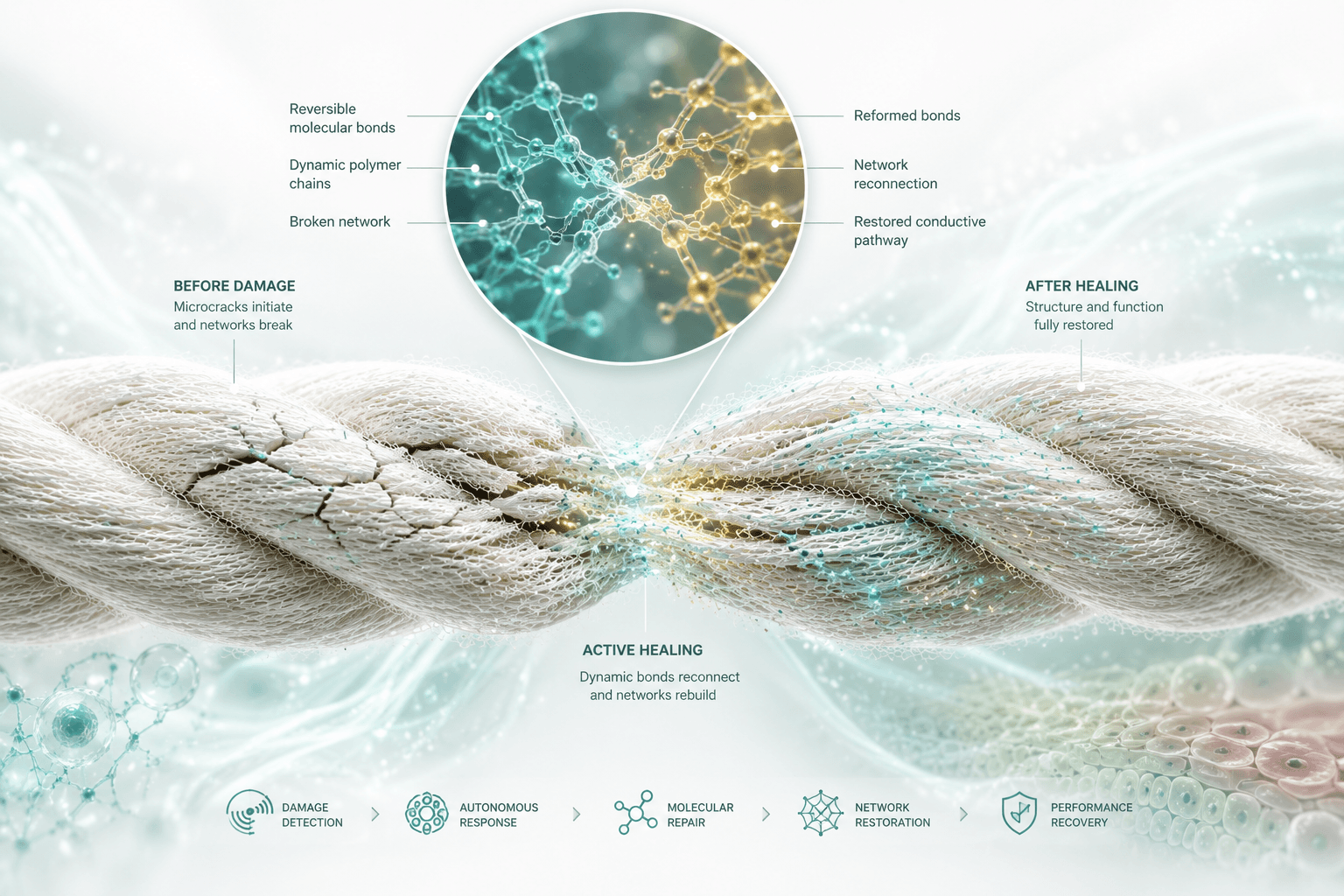
From durable materials to regenerative systems.
For centuries, durability has been one of the primary objectives of material engineering. Fibers have been designed to resist wear, withstand mechanical stress, tolerate environmental exposure, and maintain performance throughout their service life. Despite tremendous advances in materials science, one fundamental limitation has remained unchanged: Damage is inevitable.
Mechanical fatigue, abrasion, microcracking, environmental degradation, and repeated loading continuously erode material performance over time. Traditional engineering approaches attempt to delay this process through stronger materials, protective coatings, or improved structural design. However, nature demonstrates a fundamentally different strategy.
Biological systems do not simply resist damage. They repair it.
Human skin heals after injury. Bones regenerate after fracture. Plants recover from structural damage. These systems maintain functionality not because they avoid damage entirely, but because they possess mechanisms for restoration.
Inspired by these biological principles, researchers are increasingly developing self-healing fibers capable of detecting, responding to, and repairing damage within their own structures [1,2].
This represents a significant shift in engineering philosophy.
The future of advanced fibers may not depend solely on durability.
It may depend on recoverability.
1. The Paradigm Shift: From Resistance to Recovery
Traditional materials engineering treats damage as a failure mechanism.
Self-healing materials treat damage as a manageable event.
Instead of maximizing resistance indefinitely, self-healing systems focus on restoring functionality after degradation occurs. This approach recognizes that microscopic damage begins long before visible failure appears.
Cracks, interfacial separation, polymer chain scission, and conductive network disruption often develop gradually during normal use. In conventional materials, these defects accumulate until performance deteriorates.
Self-healing systems introduce mechanisms that counteract this progression by restoring structural integrity or functional performance before catastrophic failure occurs [3].
The objective shifts from preventing damage entirely to maintaining long-term functionality despite damage.
2. Healing at the Molecular Level
Many self-healing fibers rely on reversible molecular interactions.
Unlike permanent covalent bonds, reversible interactions can break and reform under appropriate conditions. Hydrogen bonding, ionic interactions, metal-ligand coordination, supramolecular assembly, and dynamic covalent chemistry have emerged as important mechanisms within self-healing polymer systems [4].
When microscopic damage occurs, these reversible interactions enable molecular networks to reorganize and reconnect, restoring continuity within the material.
Recent research demonstrates polymer systems capable of repeatedly healing after mechanical deformation while preserving flexibility and functionality [5].
At this scale, healing is not a repair process imposed externally.
It is an intrinsic property of the material architecture itself.
3. Restoring Functional Networks
As discussed throughout this series, modern fibers increasingly depend on internal networks for conductivity, sensing, energy transport, and information transfer.
Damage to these networks can significantly reduce performance even when structural integrity appears unchanged.
Consequently, self-healing strategies increasingly focus not only on restoring mechanical properties, but also on rebuilding functional pathways [6].
Conductive nanocomposite fibers, for example, can be engineered to re-establish electrical connectivity following mechanical disruption. Dynamic conductive networks can reorganize after deformation, restoring sensing performance and signal transmission.
In intelligent fiber systems, healing functionality becomes as important as healing structure.
The fiber must recover what it does, not simply what it is.
4. Bioinspired Regeneration Strategies
Many of the most advanced self-healing materials draw direct inspiration from biological regeneration.
Natural systems employ distributed repair mechanisms, localized responses, and hierarchical healing processes that operate across multiple length scales.
Researchers have translated these concepts into fiber systems using microencapsulated healing agents, vascular-inspired transport networks, and responsive polymer architectures [7].
When damage occurs, these systems initiate localized repair processes that mimic aspects of biological healing.
While synthetic materials remain far less sophisticated than living systems, the gap continues to narrow.
The future of fiber engineering increasingly involves learning from biological principles of maintenance and regeneration.
5. The Scientific Challenge: Healing Without Compromise
Despite rapid progress, self-healing systems face significant engineering challenges.
Healing mechanisms often require tradeoffs between strength and mobility. Materials must possess sufficient molecular flexibility to enable repair while maintaining the mechanical stability required for long-term performance.
Additionally, healing processes must remain effective after repeated cycles of damage and recovery [8].
Achieving scalability, durability, manufacturability, and cost-effectiveness simultaneously remains one of the central challenges in self-healing fiber development.
Conclusion
The future of advanced fibers may not be defined solely by stronger materials or more sophisticated functionality.
It may be defined by materials capable of maintaining themselves.
Through advances in dynamic polymers, regenerative architectures, adaptive nanocomposites, and bioinspired design principles, fibers are beginning to move beyond passive durability toward active recovery.
The fiber is no longer simply resisting damage.
It is learning to repair itself.
And as self-healing capabilities become integrated into future materials, longevity may become a function of adaptation rather than resistance.
References
[1] Hager et al., Self-Healing Materials, Advanced Materials, updated developments through 2023.
[2] Li et al., Self-Healing Polymer Systems for Advanced Fibers, Advanced Fiber Materials, 2023.
[3] Urban et al., Dynamic Polymer Networks and Self-Healing Mechanisms, Nature Reviews Materials, 2021.
[4] Yan et al., Supramolecular Chemistry in Self-Healing Polymers, Chemical Society Reviews, 2022.
[5] Wang et al., Reversible Polymer Networks for Self-Healing Applications, Advanced Functional Materials, 2023.
[6] Liu et al., Self-Healing Conductive Fibers and Electronic Textiles, Advanced Materials Technologies, 2024.
[7] Toohey et al., Bioinspired Self-Healing Systems, Nature Materials, extended developments through 2022.
[8] Chen et al., Challenges and Opportunities in Self-Healing Fiber Systems, Advanced Intelligent Systems, 2024.