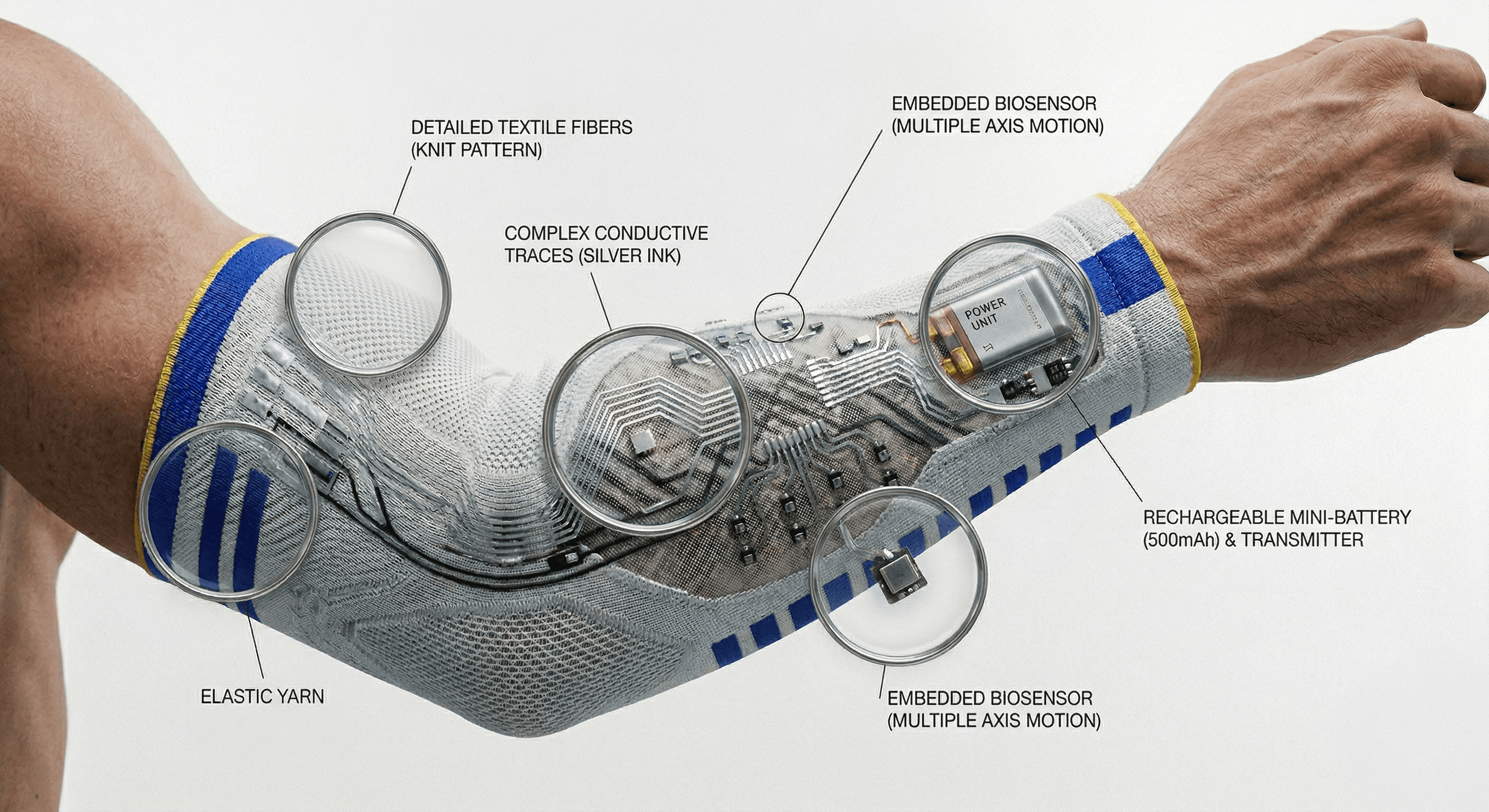
Smart wearables are often reduced to sleek designs, step counters, or heart rate monitors but beneath the surface lies a sophisticated convergence of materials science, electronics, data systems, and human-centered design [1][2].
As the industry rapidly evolves, understanding the core components of smart wearables is no longer just for engineers, it’s essential for brands, innovators, and decision-makers shaping the future of textiles, healthcare, and performance apparel.
1. The Textile Substrate: Where It All Begins
At the foundation of every wearable is the textile itself, which must conform to the body, endure repeated deformation, and maintain comfort and breathability, making it an active engineering platform [3] with the future moving toward multi-functional fabrics that integrate sensing, actuation, and protection [5].
2. Sensors: Translating the Human Body into Data
Sensors are the critical interface between the body and digital systems, with wearables integrating temperature, pressure, bio-signal (ECG, EMG), and motion (accelerometer, gyroscope) sensors [6], while challenges remain in embedding them without compromising flexibility or durability, and emerging directions include fiber-based sensors, printed flexible electronics, and continuous non-invasive monitoring [7].
3. Interconnects & Conductive Pathways
Reliable signal transmission relies on conductive pathways such as silver-coated yarns, carbon-based fibers, and conductive inks [8], but interconnect failure remains a major commercialization barrier [3], with challenges including conductivity under strain, wash durability, and signal stability.
4. Power Systems: The Silent Bottleneck
Power remains a major limitation in wearables [9], with solutions such as lithium-ion micro-batteries, flexible thin-film batteries, and energy harvesting systems facing trade-offs between weight and energy density as well as flexibility and durability, while future directions point toward distributed textile-integrated power systems and self-powered wearables [10].
5. Data Processing Units (Electronics & Firmware)
Miniaturized electronics include microcontrollers, signal processing circuits, embedded firmware that enable data acquisition, signal filtering & real-time decisions [11]
The trend is toward edge computing, which reduces latency and improves privacy [12]
6. Connectivity: From Fabric to Cloud
Communication technologies such as Bluetooth Low Energy, Wi-Fi, and NFC enable real-time monitoring, app integration, and cloud analytics, while presenting challenges in energy consumption, data security, and signal reliability [13].
7. Software & AI Layer: Where Value is Created
Software transforms raw data into actionable insights through machine learning models, predictive analytics, and personalization systems, enabling wearables to evolve into intelligent systems [14]
8. Encapsulation & Protection
Wearables must withstand sweat, washing, and mechanical stress, which is achieved through solutions such as silicone encapsulation, thermoplastic coatings, and barrier polymers, while maintaining a critical balance between protection and flexibility [15].
9. User Experience & Human Factors
Adoption depends on comfort, washability, fit, and ease of use, with the best wearables being functionally invisible to the user [16].
The Real Opportunity: Integration, Not Just Innovation
True innovation lies in system-level integration, not isolated components.
Combining materials, electronics, software, design, and manufacturability, which is where most companies fail and where the greatest opportunities exist [2].
Conclusion
Smart wearables are rapidly transforming healthcare, sports performance, industrial safety, and defense, with the next wave driven by deep cross-disciplinary integration, marking a clear shift from fabric to function and from product to platform.
** References**
[1] Stoppa, M., & Chiolerio, A. (2014). Wearable electronics and smart textiles. Sensors
[2] Heo, J. S., et al. (2018). Flexible and wearable biosensors. Advanced Healthcare Materials
[3] Tao, X. (2001). Smart Fibres, Fabrics and Clothing
[4] Cherenack, K., & van Pieterson, L. (2012). Smart textiles: Challenges and opportunities. Journal of Applied Physics
[5] Mattila, H. (2006). Intelligent Textiles and Clothing
[6] Pantelopoulos, A., & Bourbakis, N. (2010). A survey on wearable sensor systems. IEEE
[7] Someya, T., et al. (2016). Flexible electronics for wearable systems. Nature
[8] Atalay, O., et al. (2017). Textile-based conductive materials. Materials
[9] Paradiso, J., & Starner, T. (2005). Energy scavenging for mobile devices. IEEE Pervasive Computing
[10] Dagdeviren, C., et al. (2014). Energy harvesting systems for wearable electronics. PNAS
[11] Bonato, P. (2010). Wearable sensors and systems. IEEE Engineering in Medicine
[12] Shi, W., et al. (2016). Edge computing: Vision and challenges. IEEE Internet of Things
[13] Gomez, C., et al. (2012). Bluetooth Low Energy overview. Sensors
[14] Ravi, D., et al. (2017). Deep learning for activity recognition. IEEE
[15] Trung, T. Q., & Lee, N. E. (2016). Flexible and stretchable electronics. Advanced Materials
[16] Dunne, L. (2010). Wearable technology and user-centered design.